
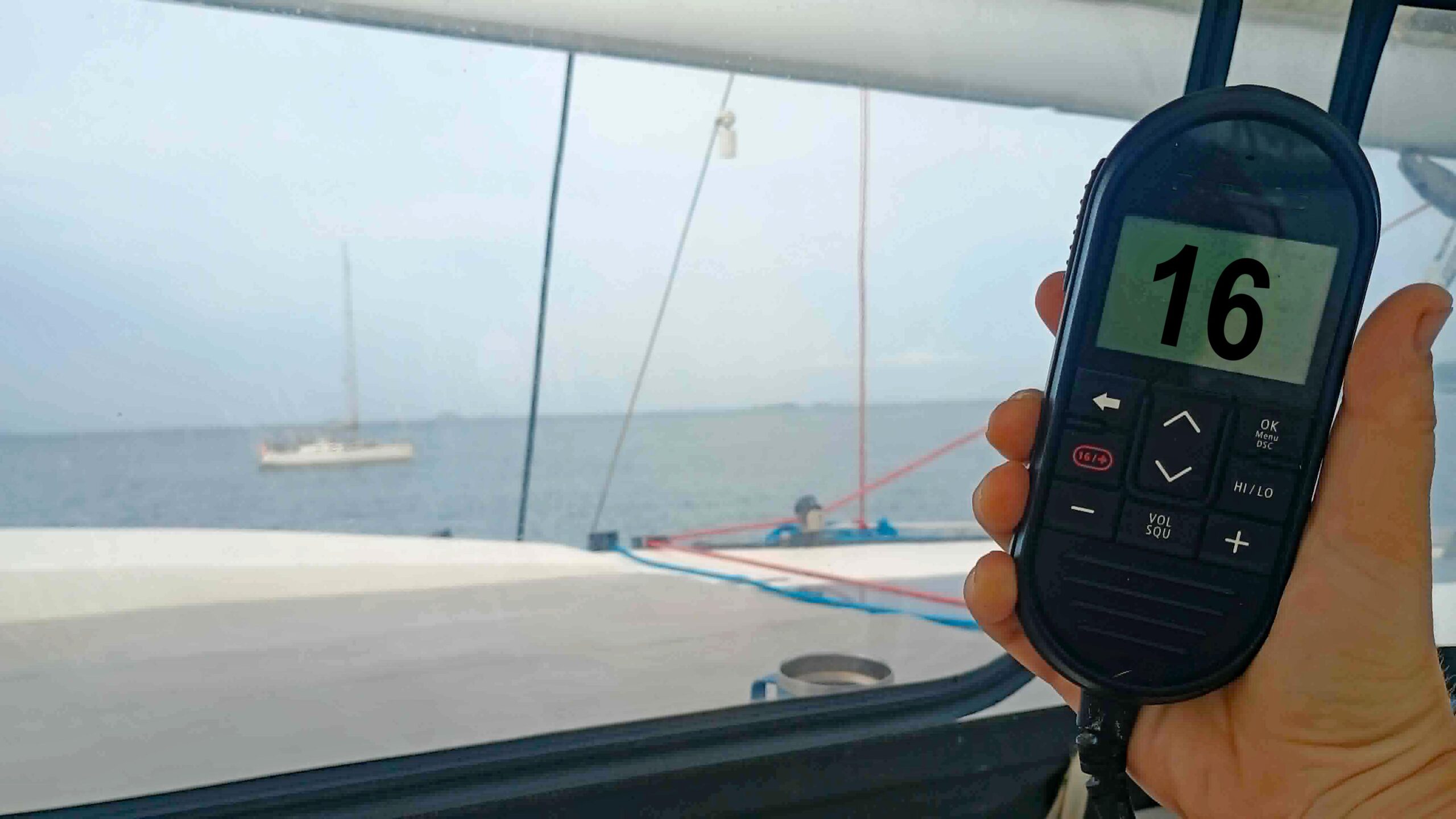
While not everyone has internet on their boat, everyone has a VHF. Depending on the vessel, United States (FCC) and International (CITU) regulations require that you monitor the Channel 16, the international distress, safety, and hailing channel, when you are aboard.
As you monitor Channel 16, you may be amazed at how many people call someone and then call a second time after not receiving an immediate response. You might wonder who was even calling, because you didn’t catch a name!
Aboard a boat there is a certain way to hail on VHF, that all crew members should know.
Hailing someone on the VHF
If you’re new to cruising, there is a procedure to hail someone on the VHF. As a rule, when you hail on Channel 16, do the following:
- Say the name of the station or vessel you are calling three times
- Say your name twice, slowly the second time
- Say the frequency
- Say “Over.”
This is a very simple and effective hail, with “Over” meaning, over to you, come back, answer me. It can be used on Channel 16, and to contact other vessels, marina’s, fuel docks and so on, on local channels.
The reasoning behind repeating yourself
Now if you are reading this and thinking; No-one says the name of the station they are calling three times, that suggestion is ridiculous, here’s why it’s not.
The first time you say the name, the receiver only hears the trailing end because you have just keyed the mike.
The second time, you are getting their attention.
Third time, they are sure you are calling them.
There is another, maybe an even better reason; if you have done this, you don’t have to repeat yourself ten seconds later thinking the receiver might have missed your call. You can wait a couple of minutes before calling again, because if someone was actively monitoring the VHF, ready to respond, they would have heard you. They may be in the bathroom, getting a coffee, talking to someone, or simply taking their time. Whatever it is, they’re more likely to be there if you wait a couple of minutes.
If you’re uncomfortable with this, remember that you can say the name of the receiver quicker because they will recognize their own name. You could also abbreviate the third time, e.g. “Green Turtle Club fuel dock, Green Turtle fuel dock, Green Turtle”.
Repeating your vessel name
Part 2 is saying your own name twice, some say three times. You want to say your own name normally the first time. The second time, say it V-E-R-Y slowly. This is because, while you know your name, the receiver does not. It is often the first time they have heard your name, so if you say it quickly it’s almost guaranteed they won’t get it right, if they get it at all. If you say it slowly, you’ve upped your chances significantly.
Why say the frequency?
You may ask, why say the frequency? Everyone knows you’re on the frequency they’re listening to…
Here’s where you’re about to learn the best kept secret of VHF radio and become a true VHF professional; Every VHF radio installed on a boat today has a dual-scan or even tri-scan feature. Some people use it, and the world will be a better place if you learn how to use it too.
Uses for dual-scan and tri-scan VHF
If you are the Green Turtle Yacht Club, who receives thirty calls a day, you can monitor the chosen local channel that’s published in advertising and customers are told to use, say, Channel 9 or Channel 14, and at the same time catch the people who look for you on Channel 16.
If you are traveling with a buddy boat or in a group, you can all monitor Channel 72 (non-commercial ship-to-ship) and chat to your heart’s content without hailing and switching on Channel 16 every time that you want to talk. At the same time, you can comply with the requirement to monitor Channel 16.
If you are cruising a commercial corridor or inland waterway you can monitor Channel 13, which is used by commercial vessels for bridge-to-bridge communications, primarily internship navigation. If needed, you can hail them on Channel 13 as well. You’ll stand out as a pro by doing it.
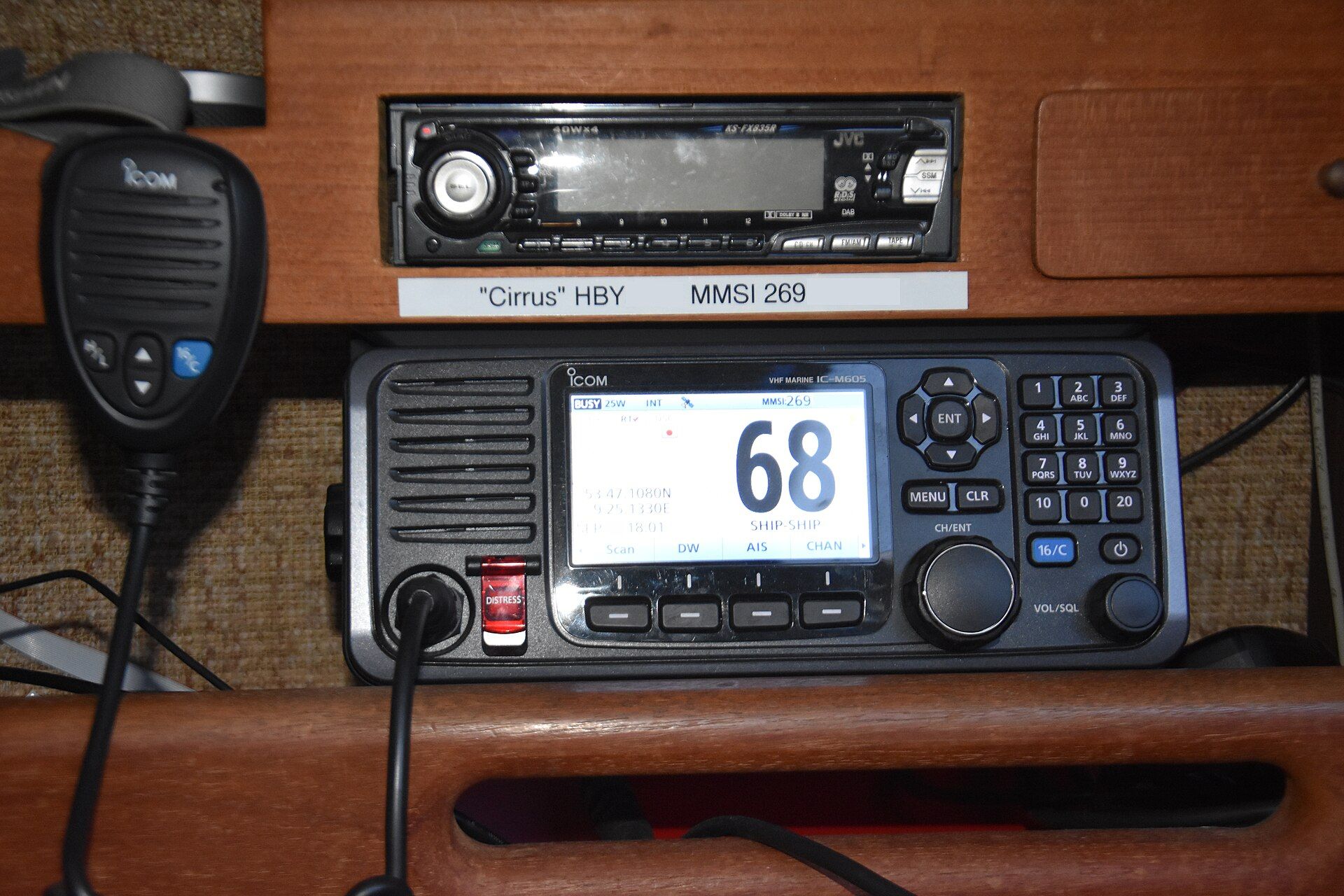
Finally, we as cruising sailors can monitor Channel 68 (non-commercial ship-to-ship) as a party line and expect to find each other there for calls that might not be appropriate nor urgent enough to warrant hailing on the busy Channel 16. If more people did this, we’d be more social than the social networks and have more fun. This practice was common in the Gulf of California and truly entertaining, not to mention useful.
There are so many reasons for fully using the dual-scan or tri-scan feature – it’s better than home baked bread! Knowing how it’s used also makes it clear as to why you should say the channel when hailing; the receiver might be listening to more than one channel and not looking at the radio to see which channel you are calling with.
Switching over from Channel 16
When someone hails you on Channel 16, switch them to a working channel immediately. Do this even in the heat of the moment, for example, if you’ve received an unneighborly “Don’t anchor on top of me” call. Simply say,
“Calling <my station name>, switch and answer on channel one-seven (17).”
Now wait for the caller to respond,
“<their station name> to one-seven.”
Then switch.
Give it a moment or five seconds for the calling station to switch, then transmit,
“<my station name> on one-seven”.
Give it another ten seconds and try again if the calling station does not respond. Follow this standard procedure and your rendezvous will be rewarded.
Often the calling station will omit their station name. They’ll say, “Switching to one-seven,” or even “One-seven.” Avoid doing that; saying your station name gives the receiver another chance to hear it. “<My station name> to one-seven.”
Which channels to use
Deciding which channel to use depends on who you’re communicating with, and why.
High power (25W) stations Channel 68 and Channel 72 are available on VHF radios and are allocated for non-commercial, general use both in North America and internationally.
Low power (1W) channels Channel 75, Channel 76 and Channel 77 are allocated for short-range ship-to-ship operations and are suitable if they are not being used for this purpose locally.
In the United Sates, Channel 9 is designated by the FCC as a working channel for small vessel hailing, while Channel 17 is reserved primarily government use. That said, it’s too handy to go one-up from Channel 16 to low-power Channel 17 when meeting someone nearby, so here common practice often trumps the imagination of bureaucrats.
You can switch to low-power Channel 13 if you’re coordinating navigation with another boat, for example, “Let’s pass port to port.” “I’ll take your stern.” That said, people often do this directly on Channel 16 if the exchange will be just as short as coordinating a channel change.
What power level to use
VHF can transmit on high-power (25W) or low power (1W). High-power transmits further, low power saves you sharing your chatter with stations forty miles away.
If you’re right next to the boat or station you are calling, hit the button that puts you on low power before transmitting on Channel 16. This is a real pro move, and you can let the receiver know by saying, at Step Three, “on Sixteen low-power“, cluing them in that they can reach you on low power and keep your conversation local.
Practical examples of VHF hails
Here are some complete examples of hailing on the VHF
| Ship to Marina | Ship to Fuel Dock | Ship to Ship |
|---|---|---|
| SV Brisa (Channel 16): “Shelter Bay Marina, Shelter Bay, Shelter Bay; Brisa, Birrrreeeeeessssaaah, on one-six low power.”
Shelter Bay (Channel 16): “Calling Shelter Bay, switch and answer channel one-four” SV Brisa (Channel 16): “Brisa to one-four” Shelter Bay (Channel 14): “Shelter Bay on one-four” SV Brisa (Channel 14): “Hi, this is Brisa. Good afternoon. I’m outside next to the channel, ready to come and dock.” |
SV Josie (Channel 16): “Conch House Marina, Conch House, Conch House; Josie, Joe-Seeee on one-six”
Conch House (Channel 16): “Good afternoon, Joshee please switch and answer on one-four.” SV Josie (Channel 16): “Josie to one-four” Conch House (Channel 14): “Conch House on one-four” SV Josie (Channel 14): “Hi Conch House, Josie is ten minutes out, is the fuel dock available?” Alternative — Direct call on Channel 14: Josie can hail directly on 14 if the marina monitors both channels. |
SV Perspective (Channel 16): “Brisa, Brisa, Brisa; Perspective, Pir-Spec-Tiv on one-six low power.”
SV Brisa (Channel 16): “Hi Perspective, switch up to six-eight.” Perspective (Channel 16): “Perspective to six-eight.” SV Brisa (Channel 68): “Brisa on six-eight.” SV Perspective (Channel 68): “Hey Brisa, long time no see. We picked you up in the anchorage there with the AIS. Cool to see you. How does it look? Room for us?” SV Brisa (Channel 68): “Woohoo! Welcome! You betcha. Right next to me.” |
Now you have it all. You’re a VHF pro. Happy cruising!
For many years VHF has been a primary form of communication for sailors, so thinking about your time at sea, what tips or VHF stories do you have to share with others?

By Douglas Lovell
After a professional life in computer science and aeronautics, and some time spent living in Uruguay, Doug bought the sailboat, Brisa in December 2020, in La Paz, Mexico. Since then he's sailed over 7000 nautical miles, taking the long way back to his adopted home.







Douglas,
A great article, thank you.
Having been at sea for many decades, I’ve found that the “blanking gap”, which is an interruption of conversation caused by the VHF radio only truly being able to monitor one channel at once, is annoying to the extent that dual or triple watch is just not worth listening too.
However, if there is no traffic, in the middle of the ocean, then dual/triple watch is much more acceptable.
Cheers
Richard
Try the 16/P button. Press it multiple times while in tri mode. Pretty cool, eh? Yes, disable tri mode when conversing or eavesdropping. When monitoring, that is most of the time, we can be available more channels than one.
I wonder if the United Kingdom is the only nation that requires you to sit a course and pass an exam in marine VHF before allowing you to transmit?
I hope there is a follow up article on the features of DSC that few people use.
no, Slovenia has it. course and exam. not an easy one…
No. France has a course too and an exam with a permit for the lucky ones
Many thanks Douglas,
As Sandy said, us Brits are required to learn how to use the VHF. Nevertheless I did appreciate learning the benefits of using it for boat to boat chats – it’s not something we’ve done since moving aboard. I will reacquaint myself with the dual and tri-scan features which I’ve never put into action.
Good article, but it fails at one important detail.
Why should the receiver choose working channel? This does not make any sense, as the receiver has no idea which channel is free or in use. The one initiating the call, should first check if the intended working channel is free or busy, then hail the receiver and then finally tell the receiver which working channel to use.
You call, your responsibility to choose an appropriate working channel!
Often the receiver has a preferred working channel. Agreed that it is courteous of the caller to be prepared to suggest one.
That is where DSC really helps out. Do an Individual DSC call selecting the channel you want to work and the receivers VHF automatically goes to that channel. No need to ‘faff’* about on CH16 and agreeing another channel.
*faff – Something that takes a lot of effort or causes slight problems.
https://dictionary.cambridge.org/dictionary/english/faff
Realy helpfull , thank you …