

I see articles about “adapting to life on board”. Having enough power to relax and enjoy living on board can be an expensive challenge. You can produce, store and use power far more cheaply with a 48V system than a 12V system.
Keep all your existing 12V loads exactly as they are — the boat systems don’t change. The only real change is running a 48V house battery and feeding your 12V system through a DC-DC charger.
Running a washing machine, cooking and watermaking, all at the same time is normal.
You are already 12 Start / 12 House / 230AC; a change to 12 Start / 48 House / 230AC can be straightforward.
Why 48?
Nominal 48V has become the standard for most serious off-grid and house battery setups. It’s the highest “touch safe” voltage, and the higher the voltage, the higher the efficiency. The same copper wires can carry 4x the power.
There’s a common misunderstanding that low voltage is more efficient. The opposite is true. Low voltage means high current, and high current means big losses in cables and connections. Modern residential AC appliances are often more efficient than 12V gear, more easily available and far cheaper. 48V can be 16x more efficient than 12V, as losses are the square of current. 12V is not some magical ideal. Cars used to be 6V, that’s now long gone too.
Purchase Cost Examples
12V System
| Item (12V) | Qty × RRP ex tax | Total RRP |
|---|---|---|
| 5000W Inverter Charger
Victron MP-II 12/5000 |
1 × €1,873 | €1,873 |
| 2500W Solar Controller
Victron MPPT 100/50 |
4 × €197 | €788 |
| Alternator 3.5kW
Balmar XT250 |
1 × ~€1,290 | ~€1,290 |
| TOTAL | ~€3,951 |
48V System
| Item (48V) | Qty × RRP ex tax | Total RRP |
|---|---|---|
| 5000W Inverter Charger
Victron MP-II 48/5000 |
1 × €844 | €844 |
| 2500W Solar Controller
Victron MPPT 150/35 |
2 × €197 | €394 |
| Alternator 5.4kW
Mahle MG1 |
1 × €750 | €750 |
| TOTAL | €1,988 |
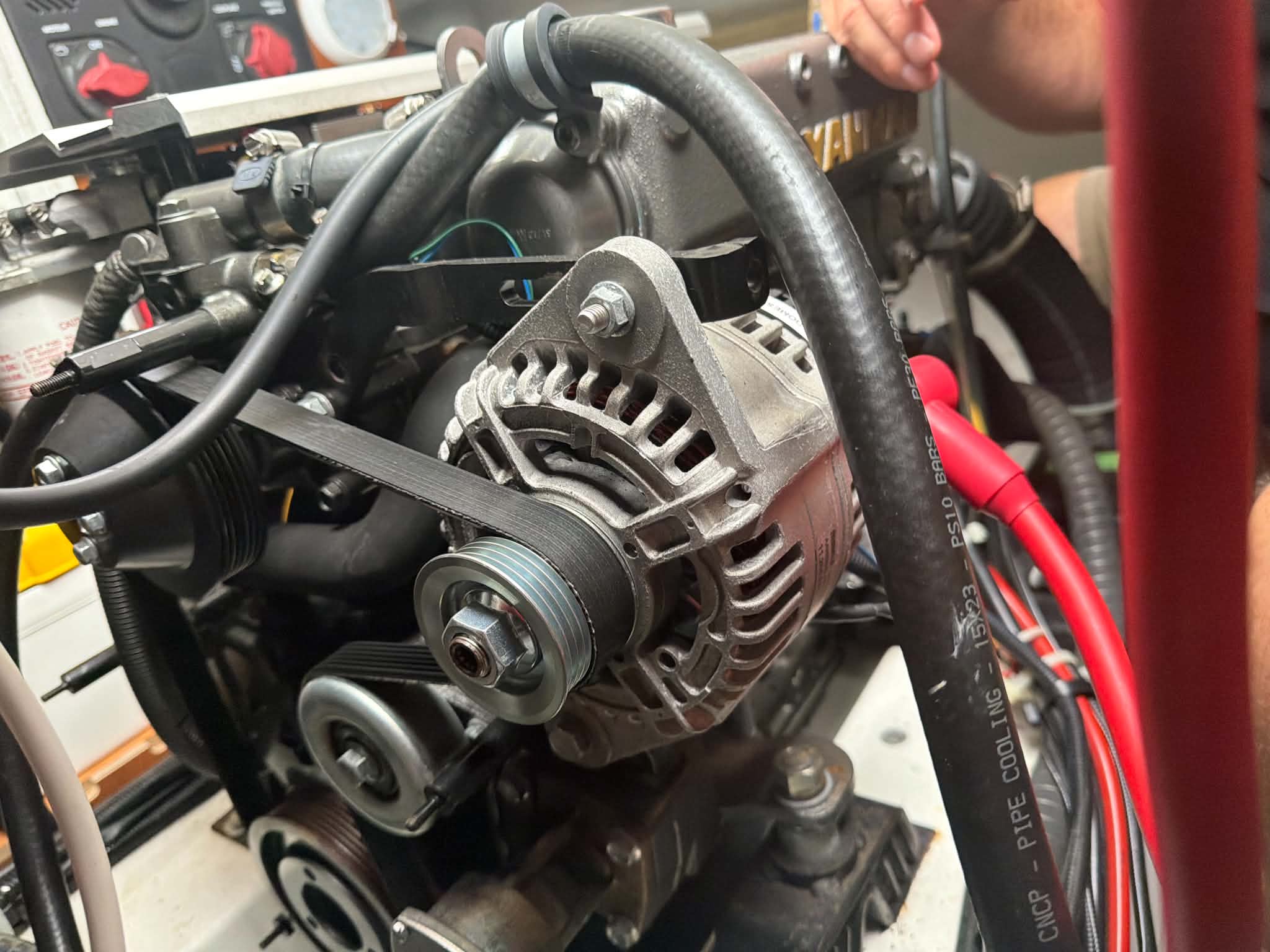
Testing shows the Mahle@7kW to run cooler than the Balmar XT250 @ 2.5kw. The difference is amazing.
Batteries are priced by capacity, not voltage. For most brands, 12V 400Ah of battery is a similar price as a 48V 100Ah battery, both having the same capacity. Victron, LiTime, Wattcycle, Epoch and many others support and sell 48V systems.
If you have 4 x 12V LFP batteries already, and your manufacturer supports it, you can simply swap the cables from 12V parallel to 48V series; do read the manufacturer specs as balancing must be considered. Whilst I prefer a single 48V battery, Victron fully supports 4 x 12V to get 48V.
Running Costs – 5 kWh into the batteries – 4X Cheaper
Generator (6 kVA) running costs for 5 kWh / one day’s power.
1 kWh makes ~100L of water.
| Charger (bank) | Time | Fuel + Maint + Depr |
|---|---|---|
| 60A Charger
12V, 360Ah bank |
8.5 hrs | €16.30 |
| 2.25 kW MultiPlus
12V, 360Ah bank |
2.25 hrs | €6.50 |
| 3 kW MultiPlus
48V, 90Ah bank |
1.5 hrs | €4.20 |
| 5 kW MultiPlus × 2
48V, 90Ah bank |
1 hr | €3.40 |
Alternator running costs for 5 kWh:
| Alternator (bank) | Time | Fuel + Maint + Depr |
|---|---|---|
| 80A
12V, 360Ah bank |
6.5 hrs | €65.00 |
| 250A
12V, 360Ah bank |
2 hrs | €15.60 |
| 140A
48V, 90Ah bank |
0.8 hrs | €4.50 |
At 48V the same energy goes in with far less engine runtime. Less fuel, less wear, and lower maintenance on the alternator and generator.
Where do these numbers come from? Your generator manual. Manufacturers publish fuel burn by load charts. Add in a generator lifespan in hours, the price of fuel and service intervals, and you can make your own cost table.
Why? Diesels need good loads to be efficient. It’s very difficult to have enough load at 12V, so the engine burns more, wet stacks and carbon builds up. With 48V, the charge rates are a closer match to the engine efficiency curve. You get less engine hours, and a cleaner running engine with longer life.
Most LFP battery brands specify charge rates up to 0.5C (2 hour, 0% to 100%) with some allowing 1C (1 hour, 0% to 100%) charging. Charge rate is rarely a problem with LFP, and with 48V the cabling is practical.
How a Normal 12/12/220V Boat Becomes 12/48/220V
You don’t have to rewire the boat. Most of your existing 12V systems stay exactly as they are.
You run a 48V lithium house bank and a 48V inverter, then use a DC-DC charger to supply your existing 12V system.
For solar – many Victron Solar MPPTs handle 12/24/48V automatically.
Because current is much lower at 48V, your existing main battery cables between the bank and inverter can often carry three or four times the power they could at 12V. This means DC wiring changes are often minimal.
An electric galley with no propane/LPG, using normal residential appliances, is a huge saving and convenience. An AC watermaker is cheaper than a DC one, more reliable, easier to get parts for, and with conversion losses, has comparable power consumption.
Common Questions
But I don’t want to convert my whole boat!
You don’t. Everything that’s already 12V stays 12V. The DC-DC charger just feeds it from the 48V bank.
Isn’t it hard to find parts in remote locations?
48V is the off-grid standard. There are far more 48V inverters around than 12V ones. Most off-grid systems run 48V, so Victron and other brands have good availability of chargers, inverters, and batteries.
Who can work on it?
Any decent auto or marine sparky who’s done a few lithium jobs can handle it. Lower current actually makes the wiring side easier in many cases.
Is it safe?
48V nominal is still considered touch-safe, and the lower current means less heat in cables and smaller fuses needed. Managing very high current with huge cables (as you do on 12V) is often more challenging.
Where do I get 48V solar panels?
You don’t need special panels. Just wire two normal panels in series so the voltage suits the MPPT.
What about 24V?
24V is generally no real cost saving over 12V as it’s not a common off-grid standard. It’s often harder to find good 24V equipment.
What if my 12V start battery fails — you can’t parallel it with the house bank?
That’s true, you can’t parallel them. I run a Victron battery monitor on my start battery so I always know its condition. The start battery is kept perfectly charged 24/7 by the DC-DC charger and monitored through my Cerbo GX. I also carry a small portable lithium jump starter, but I’ve never needed it.
I see some equipment at 48, 54, 56 and 58V. What’s that about?
Nominal 48V runs charge voltages up to 58V depending on the equipment. That’s normal and is regarded by most standards as “nominal 48V”.
What do you have on your boat?
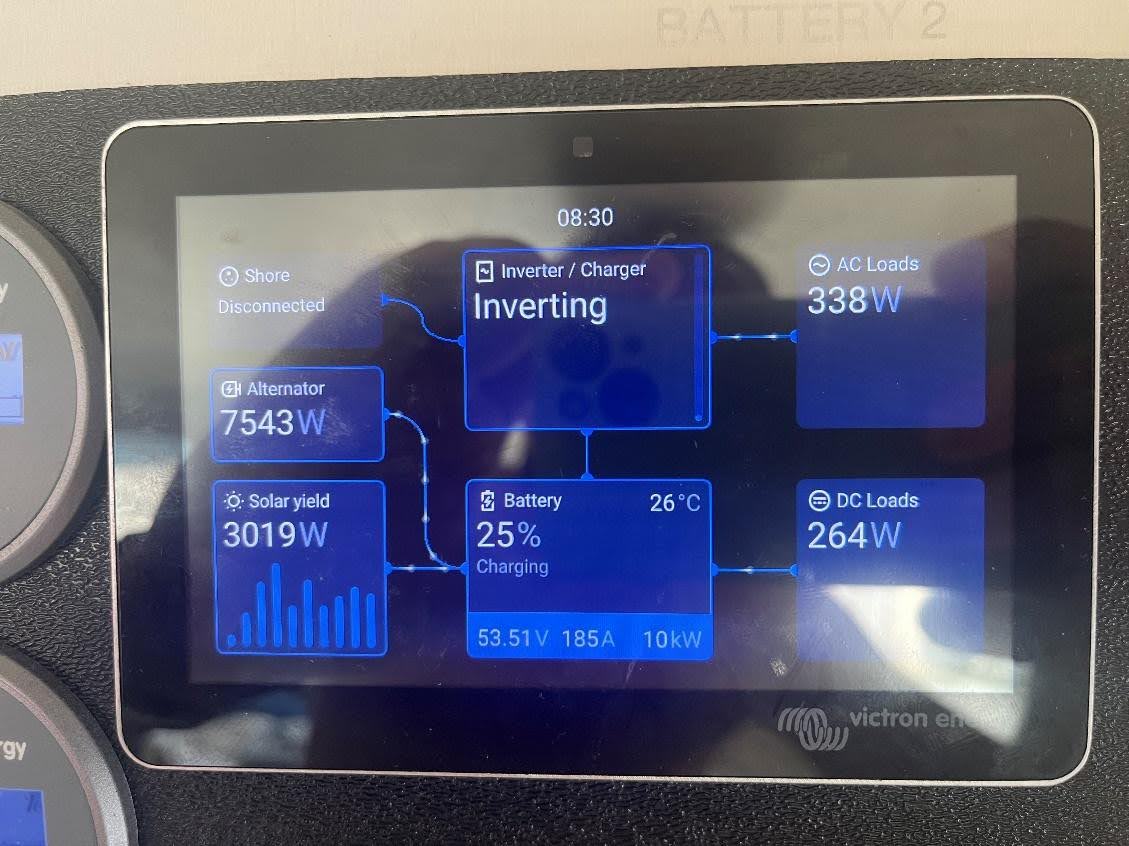
We have made Razzle Dazzle a little special. I wanted living aboard to be “easy”. We have 5.25kW solar, 10kW inverter, a 30kWh battery and 9kW alternators. No genset. We run air conditioning 24/7 over summer, no propane, all electric cooking, nearly unlimited water, electric hot water, and we don’t worry much about power. If we need more power and the sun is limited, we (very rarely) turn on an engine and make 7–15kW from the alternators. I added a new deep freezer last season for €130 retail, it’s not “Marine”. All this on a real blue water performance cat that we have cruised on for six years. 48V makes this practical.


By Paul Young
I have been designing and building off grid systems for remote mine sites for 25 years and cruising full time with my family on Razzle Dazzle since 2020. One of our main criteria was "enough energy to be easy". That means lots of solar and a system that can be like living and not camping. I think we achieved that.







most people aren’t trying to compete with a nuclear power station. This wont suit 95% of boats out cruising. not everybody wants or needs air conditioning. If you didn’t insist on running AC at night you could have a far more simple and robust system. what’s you plan for a lightning strike?
The discussion is cost. 48v is cheaper than 12v to buy and to run.
Both are equal for lightning.
Feel free to run your own numbers, but in most cases, when upgrading, 48V works out significantly cheaper than 12v to both buy and run, both at the same capacity / size.
12 or 48 are equally damaged by lightning.
I think you are trying to say “minimise electrical systems”, as does Lyn Pardy, who writes very well on why she likes kerosene lanterns.
Why was this reposted omitting my previous comment?
Your article fails to mention how you would deal with all the high amperage dc loads, like bow thruster, electric winches, electric furling systems, dc water makers, etc. It’s not a retrofit option worth taking seriously.
Regarding your first question, an update was made to the article that wiped all previous comments. It was on the Magazine side and nothing to do with the author, Paul, who kindly volunteered his time to share his knowledge and perspective on the topic. – Telicia Campain (Editor of noforeignland Magazine)
In our boat (61ft Cat) we run all 12v from a single monitored AGM, as per the article. You could use LTO but we chose AGM six years ago. Windlass, winches, engine starters, the lot. It never goes under 90% SoC, except the one time I forgot I turned off the DCDC breaker and the battery monitor alerted me at 50%. Our watermaker is AC as it’s about saving costs, but you could do up to 40-50A 12v DC, or parallel DCDC if you need 80+ A continuous if you already owned that.
A bow thruster does need specific consideration. They mostly have their own battery.
Hi Paul,
It is really tempting as we are about to repower and replace batteries. One question we have is about starter batteries – you noted that your starter battery is always charged from 48V system. Does it mean when engine is running, it does not charge starter battery directly but rather, charged from 48V house battery system? We need to scrap the existing dial switch of off-1-all-2? Is there a safety measure to prevent 12V from discharging to 48V system?
We have one remaining 12v alternator that is connected to the 12v AGM. It doesn’t do anything, as the DCDC keeps the AGM at full always. Our 48V alts are 10x more powerful in the same size, and really, solar does most of what we use. There is no connection from 48-12. If you somehow lost all 48v charging – solar and alternator – the 48 will give everything to keep the 12v fully charged. Thats one lot of alarms. Once the 12v hits 50%, thats a second lot of alarms.
If you manage to flatten your house and start battery, with solar, whilst ignoring alarms, you might want to look at your system. But even then, I have a jump starter.
The only challenge with this becomes items with large power/load requirements. Thinking specifically winches and windlasses. What DC-DC converter are you using that will provide ~2000W? (~166A@12V) If your system is Victron you will need 5 of their largest isolated DC-DC converters or 3 non-isolated converters giving you ~180A. Is there a way to use a smaller 12V bank to act as a buffer during times where you might exceed the 12V load capacity?
As per the diagram, we use a single AGM for 2 engines, windlass, winches, all 12v systems. We use a 100/50 mppt as a 48-12 DCDC due to limitations in the Orions. That means I can use any MPPT in an emergency. IMO having a battery monitor on every battery bank on your boat is important. Start batteries in hot engine rooms ignored for years are begging for failures.
Got it. Don’t think the diagram loaded the first time. We run a 48V bank on our boat. That said we have a 12V starting/nav batteries AND a 24V bank fed via DC-DC from the 48V bank. It’s why I was wondering how you deal with larger loads. The 70A MPPT is a great idea and would cut out the 3x DC-DC converters we currently use with just an increase in cable size from controller to battery. Thanks again.
Caution. The 250v mppts dont work. Stick with 150 or 100 versions.
Using a dc-dc converter, though the standard recommendation, will lead to excessive voltage cycling as you need a decent voltage drop before the converter will starting making up the difference. A proper speced out solar controller provides the same benefits of keeping the 12v topped off, but is much more responsive eliminating the cycling problem. Also, since a good solar controller provides good metrics its much easier to track the 12v consumption separately from the 48v consumption.
Exactly. Add in the Victron 48-12 options dont have Ve.smart, so no accurate V sense, Temp sense or charge profiles, and for an AGM, using a smartsolar is much better than using an orion. Just avoid the 250v versions, they are not suitable due to their safety search profile.
Which controller are you using for the alternator? It seems like they are usually either unreliable of very expensive.
I have a WS500 on one (5yrs) and Zeus on the other (2yrs). They do have their quirks. Many ways to skin that cat.
48v is the way to go
i have 12v and 48v inverter 3000w and 5000w
i have full electric kitchen running on 48v inverter
i have my old 12v inverter sa backup and charger if i need more power when solar is not enough ( i only have 12v altonator so i can run the engine and then the 12v inverter and charge my 48v battery with the 48v inverter 😍 im super happy with that, i like that the amp only is a quarter of 12v system so much better for the cabling, and my inverter and battery is only 30cm apart short cabling same with the mppt
I concur with Paul. I have a large Catamaran and I have run a 48v backbone throughout and added DC DC converters where required. this has resulted in much less and smaller wiring and offered substantial savings. My vessel is hybrid electric that I designed my self using a constant current diesel generator which is in credibly efficient, solar, and regeneration. I barely use the diesel except when I need to run the motors for more that 5 hours. i run starter and windlass from separate 12v battery as per Paul but would prefer to be 48v. my dinghy has 3kw out board at 48v and when on board is plugged into central 48v backbone and is charged as per house and becomes extra storage for house.
Looks like my initial response was wiped out so I’ll just say thank you, this was a very well written and helpful article. 😀