

As we eased into the cruising lifestyle, starting from doing short jumps of 20-40 nautical miles and having a plethora of food options, to heading off to the Bahamas for a couple winters, we have loaded up the boat and learned a few valuable lessons about meal planning and provisioning.
The development of our provisioning skills started when we motored our Hunter 376 fifteen days from Shelburn, VT back to New London, CT. We managed our provisioning (if you can call it that!) like we would at home – make a list of essentials, organize a couple planned meals and let the rest fall into place. I mean the grocery store is just down the street right? My, how we were so wrong! This plan turned into eating out, spoiled food and wasn’t exactly budget friendly for our long term plans.
We started thinking about our food consumption like camping, and I think many of us do at first, trying to revamp our diets into granola bars, oatmeal, 1 pot rice meals, prepackaged Mountain House meals and anything that is super easy to make. This leaves a lot to be desired, and you end up with a bit of stuff that inevitably hangs around the bilge for too long.
What to buy and what not to buy, that is the question
After our first rations of granola, oatmeal and Mac ‘n’ Cheese, we really needed a change. We craved salad, fruits and good hearty ingredients, leading to the conclusion that you shouldn’t revamp your eating habits just because you moved aboard! When choosing what to buy, you should consider what you ate at home, how you have cooked up until now, and what dietary restrictions you might have.
Over time our meals became more planned, which guided what we did and didn’t buy. Back on land we’d occasionally made home-fries, and after a year aboard we missed that treat dearly. We started buying potatoes to make them, with a plan in mind to use those potatoes for another meal, either that night or in the next days, before they started to turn. Another example is bell peppers. At the start, leaving a bell pepper in our boat fridge typically turned into throwing out the pepper a few days later. After cruising for a while and planning ahead, we would use some of the peppers to make omelets for breakfast, then use the rest to make a stir fry or a curry in the evening.
Finding affordable meat
For the carnivores that can’t live without a steak, we found it was easy to stock up and freeze meat, provided you have the space. Space is at a premium on a boat, and the fridge and freezer are no different.
In our second season cruising the Bahamas we bought a small Bouge RV freezer to let us bring a little more with us. After the first year and experiencing the chicken in some of the lesser traveled locations of the Bahamas, we felt it was better to bring along what we wanted. Unless you are a really great spear fisherman (woman) living off in-season fish and lobster isn’t always realistic, and you can quickly find yourself at the local grocery store trying to locate a decent piece of meat. Most meat in the Bahamas has proven to be fairly expensive, while chicken, ribs and ground beef is tolerably priced at best.
Over-packing dry goods
Something we learned; it’s important to consider that around the world people do have food, so you don’t need to over-pack on things that you can get elsewhere for a reasonable price.
For our first season in the Bahamas we bought two large bags of rice; one was 50 pounds and the other was 20 pounds. After buying that rice and carefully packing it in vacuum sealed portioned pouches, we still have that original rice in our dry goods. What we didn’t think about at the time was rice is a worldwide product, and you can buy it anywhere relatively easily and cheaply. There’s no need to take up precious space in your bilge with rice when you can have a plethora of candy bars, your favorite coffee, or that precious adult beverage, which tend to be so much harder to find at good prices when you’re off exploring islands.
How long to plan for
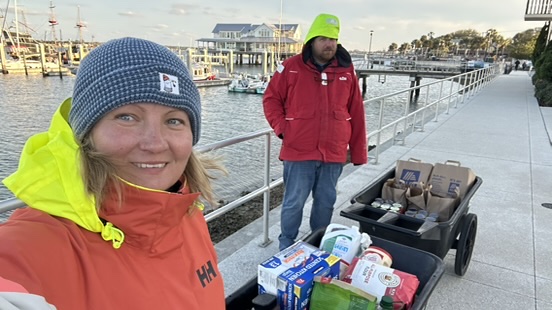
When we cruised the east coast of the USA down the ICW, groceries were fairly easy to come by and much more affordable than the Bahamas. We’d plan for about 1.5-2 weeks worth of food and meals, not including essentials like eggs, bread and fruit. This allowed us to move the boat between cities and have enough aboard where we didn’t feel like we were rationing the things we loved.
Larger provisioning runs for the Bahamas winter season are very different; we are buying things we plan to use over the course of 4-5 months.
It starts at Costco where we can buy things in bulk, such as big bags of Kirkland mixed nuts, large containers of instant coffee, bulk spaghetti, bulk Mac ‘n’ Cheese, flour and pancake mix. We typically keep a running list of what we use, including how much we had at the beginning and the end of our trip, to help with future planning. For example, pancakes are a staple in our house – our daughter loves them! In a season we would use about five 5lb bags of pancake mix. They are bought in resealable packaged bags and last about a month and a half between the three of us, so in a cruising season of 4-5 months those five bags gives us enough to get us through the Bahamas and back to the States to buy more.
In the Bahamas we can supplement the provisions bought in the US. The ground beef, fish and lobster are typically very fresh; lobster tails right out of the ocean can be had for about $10.00 – $20.00 depending on the time of year. We also found that in most remote anchorages, where cruisers want to visit and spend time, you can catch or spear your own fish. Keep them smaller than a dinner plate, and you should be fine to eat them.
Tips for packing it all away
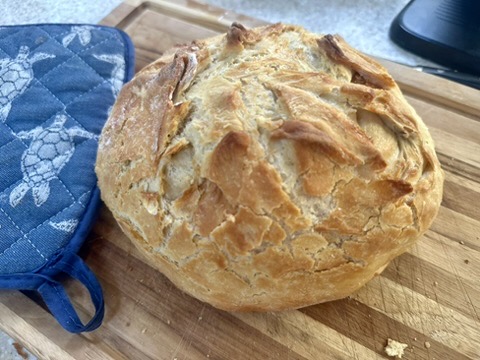
A few folks we have run into have told us stories about their own provisioning nightmares, including experiences of undesirable critters in their bilge chomping through provisions like its their own personal grocery store. Luckily, we have avoided these problems so far, with the exception of one bag of flour.
Vacuum sealing dry goods
Early on, during our first southbound transit, friends advised us to vacuum seal our dry goods to avoid having these sorts of issues. We followed their advice and bought a vacuum sealer of our own. Having had it a while I think was a good buy for us, as we have used it for macaroni, flour, meats, rice and other dry goods. We did experiment with storing our macaroni boxes, but found they became damp when left in the boat for too long which invites mildew, mold and critters. Overall we think its best to be safe rather than sorry, and plan for the worst. By vacuum sealing your dry goods they will last, even through window leaks, water in the bilge and the plethora of other issues which may arise.
Removing can labels
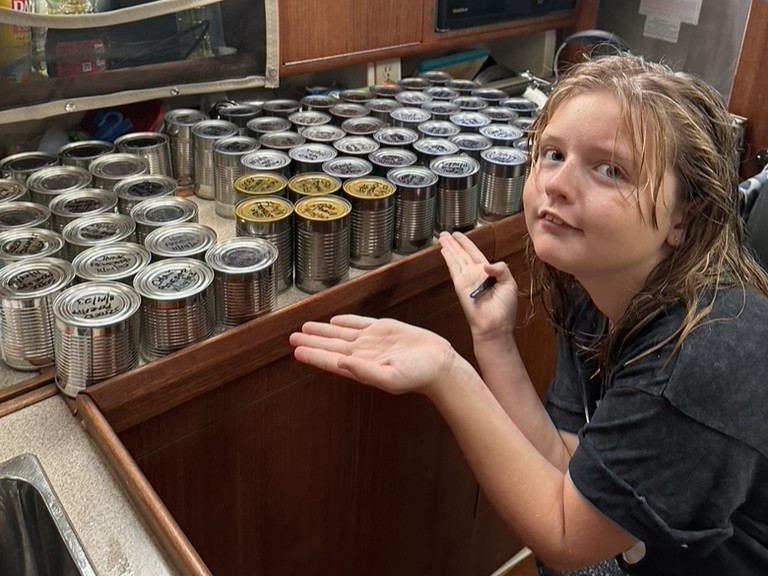
It’s best to remove your canned goods labels. Make sure you write what’s in the can and the date it was stored on the lid, using permanent marker. Recently I opened a can of what I thought was tomato soup, which turned out to be diced tomatoes. Looking at the handwriting it was clearly written by our daughter, who was the one that wanted tomato soup in the first place. We had burritos that night instead.
Accessibility
Ensure that you have some sort of organization to what you are putting away. On our boat, we have nice big storage areas in our saloon seating. We specifically packed our dry goods in sizes appropriate for the space, and stacked them neatly vertically so there was no need to move things around to access rice, macaroni or typical everyday use items. Cans are stacked in the bilge with the same product on top of one another, i.e. corn over corn, green beans the same, and those precious canned mushrooms for pizza night on top of each other.
Cold space puzzles
We typically cook aboard, with the exception of a once a week restaurant splurge (averaged over the season). As a result we usually have a bit to refrigerate or freeze, and fitting everything in can be a puzzle.
Personally, we dislike dumpster dive top-load fridges; we had one in our first Hunter and struggled with how to manage the space best. We found that buying plastic bins kept things somewhat under control, but they should be sized for the space and stackable. Having bins allows you to quickly and effectively remove bulk items out of the way and onto the counter, then put them back quickly as well. The most used items were kept on top, like eggs, sandwich meat, cheese, ketchup and milk, and less used items below.
We do a similar thing in our front-load fridge now, which was one of the required parameters for our new boat. There are clear bins which we use as draws to slide things in and out as needed; it works pretty well, keeping food organized and making the fridge convenient to use.
The freezer gets loaded up with steak, pork, chicken, frozen broccoli and some ice cream, with the ice cream always being at the bottom. We portion our meats into single meal amounts and freeze them accordingly. The meats are then stacked in our storage freezer so we can pull out what we need, and restock things where we find them. We have done offshore meal-prep for longer runs and do cook in advance for those times, but are normally departing from a location where a store exists and is accessible, or if needed we utilize multiple pre-packaged meat packs.
Storing vegetables
As mentioned, we take some frozen broccoli as well as canned vegetables, with romaine lettuce and carrots being the only things we refrigerate when we’re cruising. We eat a lot of cabbage when out, as we make a good coleslaw. For other fresh vegetables, like tomatoes, potatoes, onions, and peppers, we plan our meals around their typical shelf life and the time spent between anchorages we’re visiting and places we can stock back up. In our experience, all of the vegetables in the Bahamas have been very good quality.
The art of provisioning at sea
These are just some tricks and tips we have learned over the past couple years, sailing between the States and Bahamas. We would love to hear from people who have some tricks of their own, so if you do have something that works really well, please put it down in the comments and let us know.

By Anthony Swiacke
Tony, Anna, Sophia and Bolt have been sailing the east coast of the USA and the Bahamas for the past 2 cruising seasons and have plans to continue further south into the Caribbean. They are electricians, digital creators, and students.






Great article. We found the biggest thing to take with you is fresh meat. Just about everything can be bought with a little effort. Biggest trick is finding where the locals shop. Some of the grocery markets at Spanish wells, nausea and marshharbour are worth visiting. We found groceries cheap on Long Island than Georgetown.
Thank you. The groceries in Spanish Wells and Marsh Harbour are great to see after being away for so long and now heading back north. Rock Sound, Eleuthera is another spot with a surprisingly large grocery store. It definitely feels more like an extension of the stores we have in the States rather than a typical tropical paradise.
Great ideas. one to consider is buying a 50-75 liter 12v cooler box that can be stored away under a bed when not needed or bought out for long cruises. Perfect whenever your fridge or freezer compressor goes faulty (try to source a 12V compressor in a remote location). These can be configured as a fridge or freezer and have a remote app to monitor temperature from your phone (if used for long term storage).
We recently bought a bouge rv unit that we really like and is perfect as a deep freeze or a spare option for refrigerator or freezer. This is an excellent point and great idea for a v