

One of the fears people can have before moving aboard is that cruising life will feel lonely.
It’s a fair concern. You leave friends and family behind, you move constantly, and often you drop anchor in places where you know absolutely no one. But here’s the funny thing; cruising often creates one of the most social lifestyles you can find in this modern age.
From the outside, an anchorage might just look like a collection of random boats. But spend a few days there and something interesting usually happens. Conversations start, dinghies begin tying up next to each other, and before long someone is organizing something fun. And once those connections start, they often follow you up and down island chains, and across oceans.
The floating neighborhood effect
Anchorages, boat yards and marinas function a bit like small neighborhoods. Boats might arrive from different parts of the world, but for a few days, weeks or even months, everyone shares the same view, the same dock, and often the same grocery store or chandlery. That proximity naturally leads to interaction.
You see the same dinghy pulling up to shore. You recognize the crew from the boat next to you. Someone calls on the VHF or puts a message out on the local chat asking about fuel docks or fresh produce. You become part of a temporary little community filled with people who made the same choice as you – to leave land behind for life at sea.
Classic ways cruiser friendships start
No matter where you go in the world, there are a few common ways that cruiser friendships tend to begin. Some start with a random encounter at a beach bar, while others are grow from an organized event.
Sundowners
If you’ve spent any time cruising you’ve probably heard this word already, but “Sundowners” is basically the cruiser version of happy hour. A few crews gather, everyone brings a drink or snack, and you watch the sunset together.
Sometimes it’s on a boat. Sometimes it’s on the beach. Sometimes it starts with two people and suddenly turns into fifteen.
When we spent time on the hardstand in Trinidad, the social scene was particularly strong. Sundowners on the dock at PowerBoats were a near nightly occurrence, but they were only part of it. There were also weekly BBQs, the Saturday market trip, and one hurricane season, a morning “Walking Club” formed. That just by itself evolved into pizza lunches, poker games, waterfall excursions, bike rides, morning hikes followed by a smoothie stop, and yoga sessions led by cruisers volunteering their skills.
It felt less like a random boat yard of people, and more like a small village. The best part, was that many of the friends made there ended up crossing paths with us again later, as we sailed through the Eastern Caribbean.
-
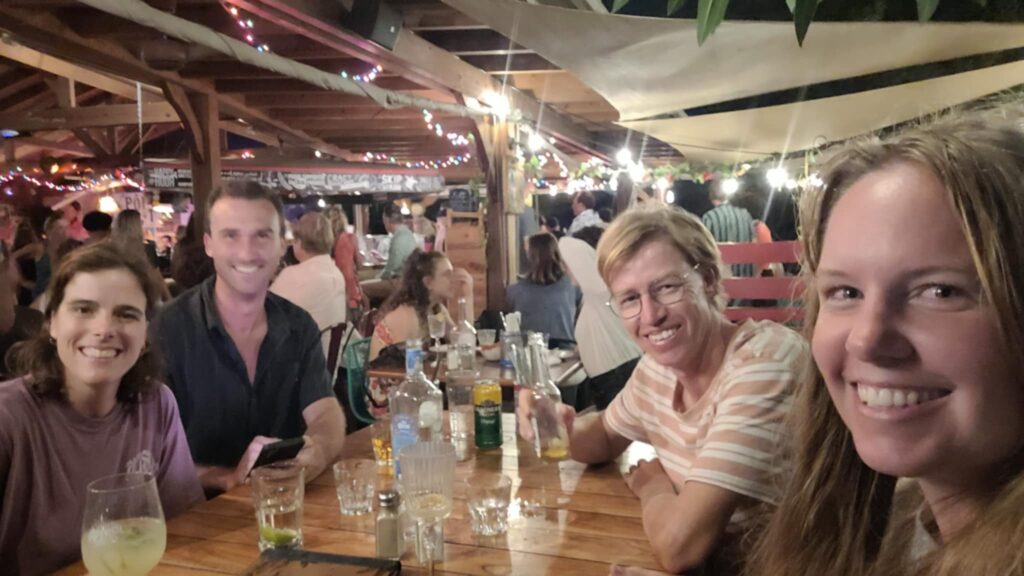
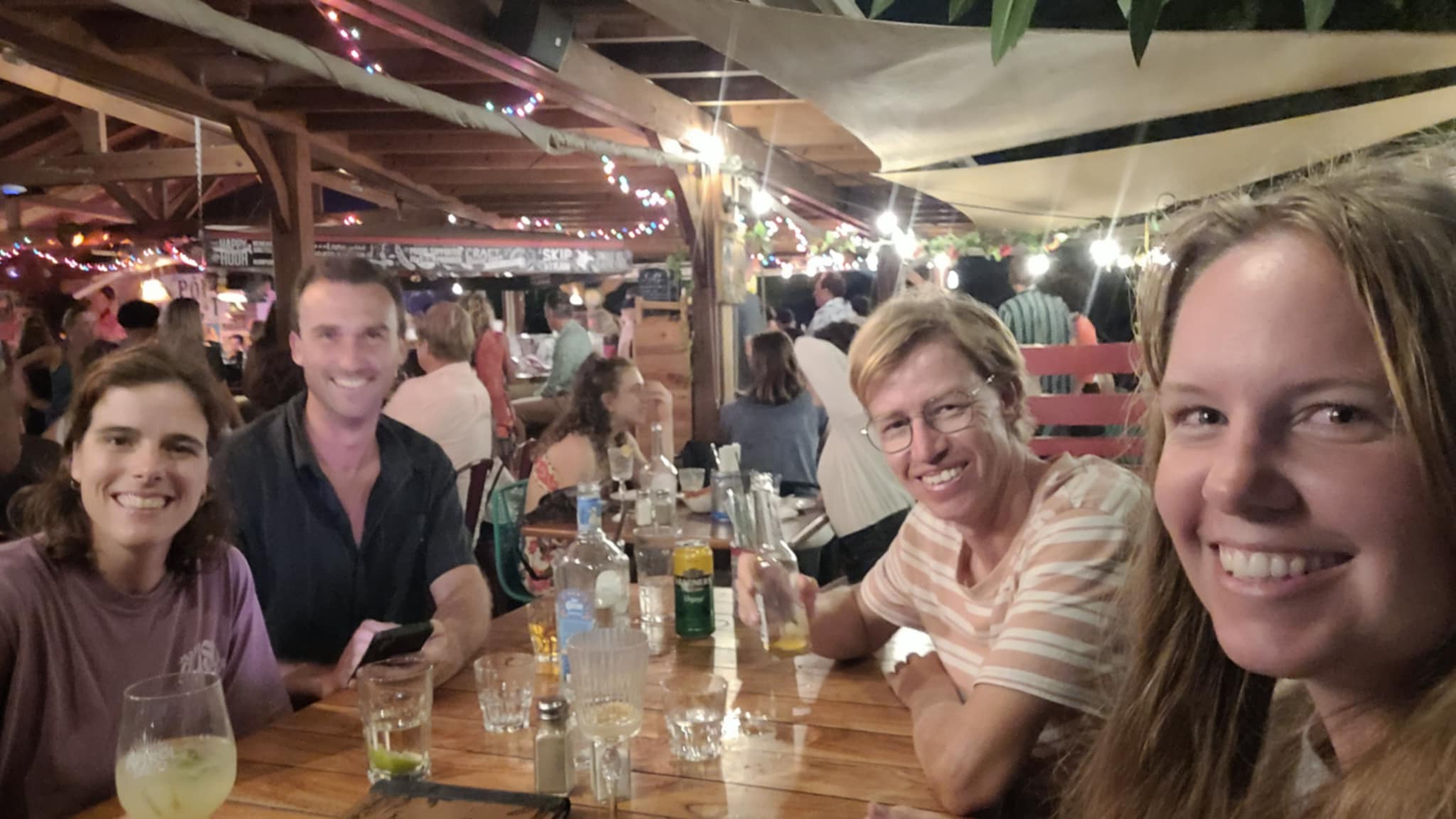
- Catching up at Lagoonies, over 450 NM from where we first met
Cruiser events
Organized events are a great way to meet people. In some places it’s a weekly potluck. In others it’s a BBQ, bonfire, or even beach volleyball tournament. These events make it easy for new boats to join in without the awkwardness of introducing yourself out of nowhere.
One of my long-term cruising friendships actually started at a cruiser BBQ. We connected over similar interests, and what grew from that is a genuine friendship that’s lasted the distance, despite not seeing each other in person for over a year now. And that’s pretty typical in the cruising world.
-
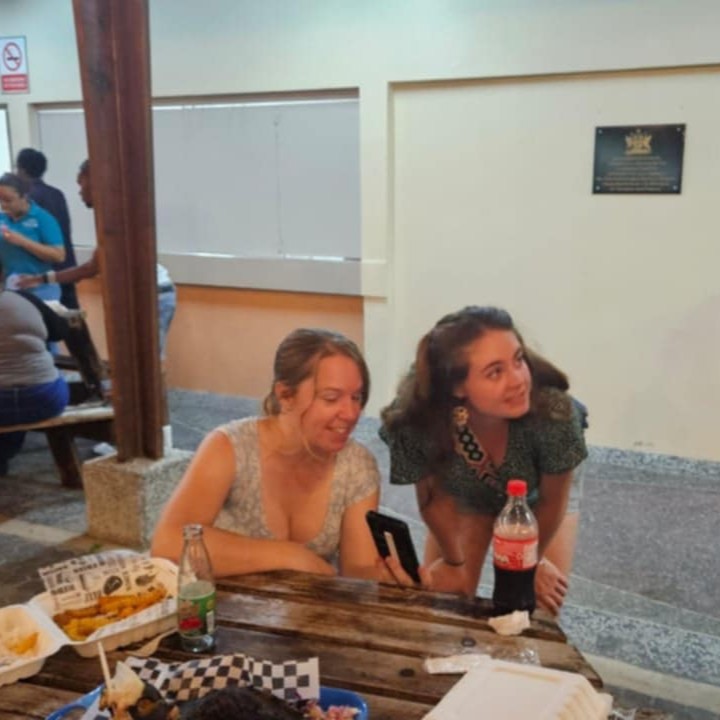
- Fish Fry excursion
-
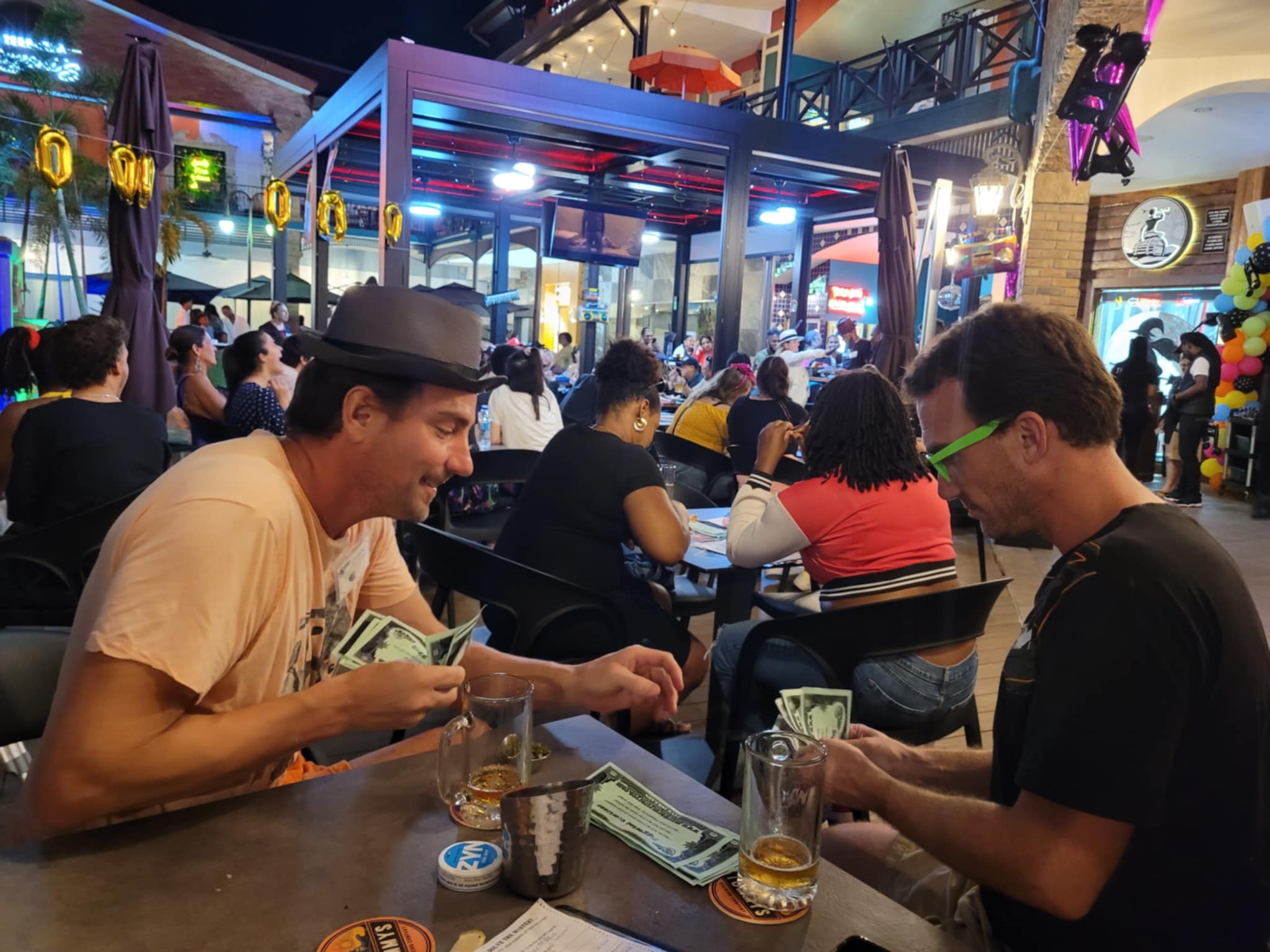
- “Murder Mystery” event
Boat problems that accidentally lead to friendships
Boat ownership guarantees one thing – something will break. But, those moments often create connections as well. Someone might help you grab a line at the dock. Another cruiser might lend a tool. You might start chatting while troubleshooting an engine issue in the cockpit. Before you know it, you’re sharing a beer afterward.
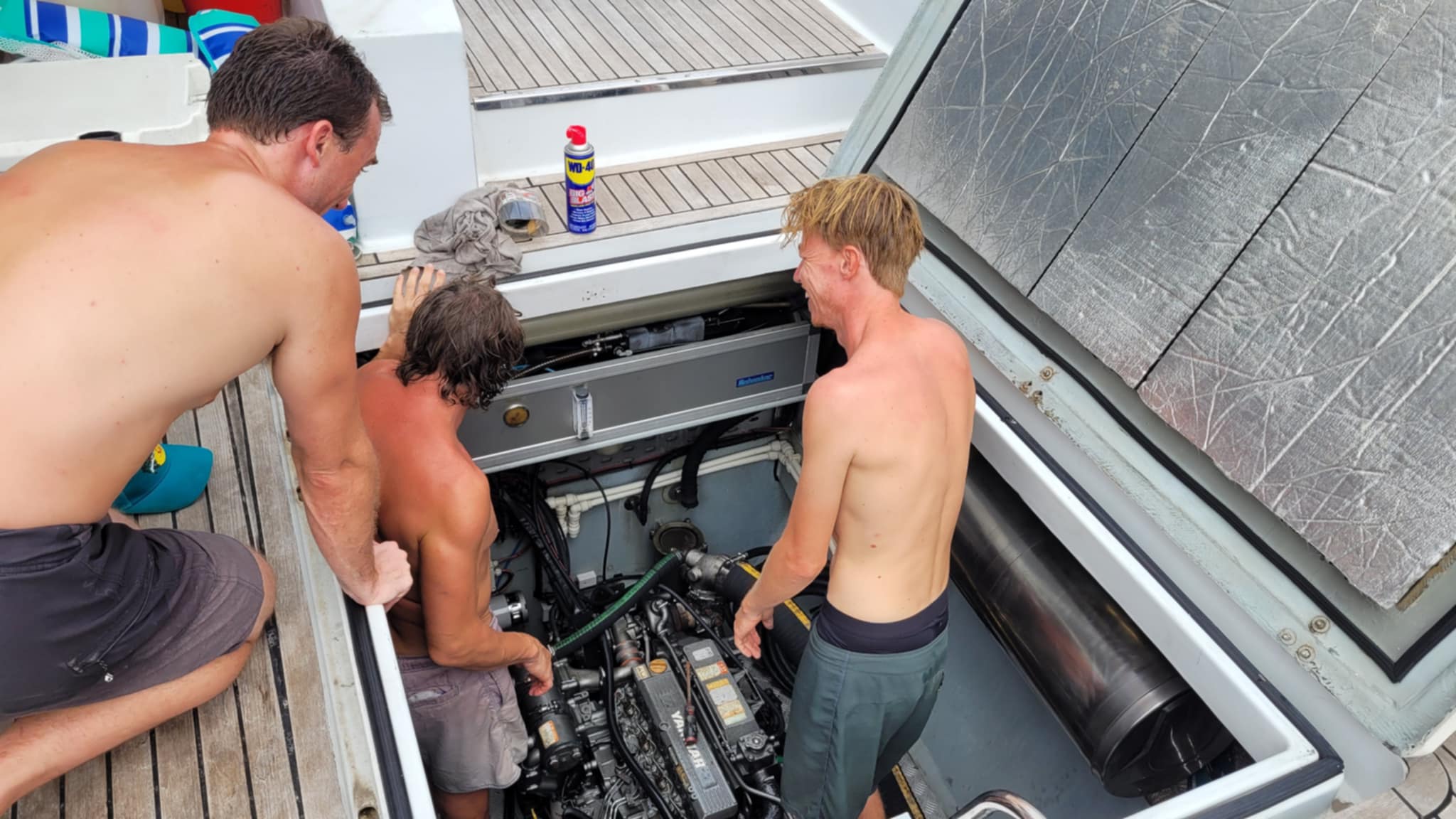
I always laugh when I look back at the photo below – three boat captains working on a watermaker problem, belonging to the fourth captain who’s out of frame.
-
- Broken watermaker
Modern ways cruisers connect
While the social side of cruising has always existed, technology has added a whole new layer to it. These days, many cruiser communities are organized online long before people even meet in person.
Facebook cruising groups
Facebook groups have become incredibly useful for cruisers, and almost every major cruising region seems to have one now. The Mediterranean Sea, Atlantic crossing, Caribbean islands, Pacific archipelagos – even individual anchorages sometimes have their own groups.
They’re brilliant for asking general questions like:
- Where’s the best place to buy X part?
- When is customs open over the weekend?
- Is anyone else planning to make the passage north?
But they’re also used to organize social activities. You’ll often see events pop up in these groups that bring cruisers together, like BBQs, trivia nights, group hikes, beach cleanups and local cultural experiences.
WhatsApp groups
If Facebook groups are the big public noticeboards, WhatsApp groups tend to be the hyper-local version. Many anchorages, marinas and boat yards have their own WhatsApp chat where boats share real-time information.
Things like:
- Security, Customs, Immigration and importation updates
- Grocery runs
- Ride shares
- Social events
- Questions about where to find something or requests for assistance
These chats can get surprisingly active, especially during busy cruising seasons, and once you’re added to the group, you suddenly feel connected to everyone around you.
The other way Whatsapp groups are used is to connect over vast areas where boats are more sparse, such as the Pacific islands, or ocean crossings. A prime example of this is Finding Dory, created for the East-West transatlantic crossing.
Using noforeignland to connect
One of the biggest challenges when arriving somewhere new used to be figuring out who else was around, and that’s where tools like the noforeignland have made a real difference. Instead of wondering which boats are cruisers, you can often see exactly who’s in the anchorage, and if there’s anyone you might know.
Seeing who’s nearby
The map makes it easy to spot other cruisers in the same area, and sometimes you’ll recognize a boat name immediately. We’ve used it many times to see if friends we’re expecting have arrived, or to check who else is currently anchored in a location.
Boat groups
Another feature that’s quite useful is Boat Groups, especially groups like Kids4Sail, Single Handed Sailors, and Pets on Board. Here you can start group chats with like-minded people or sailors with a similar situation, then connect individually through messaging. At the moment, it’s helping me connect with other pet owners who are planning to sail to French Polynesia this year, while families with children have found it to be a great way to connect.
Events on the platform
The events feature can also help bring cruisers together – whether it’s a gathering at a marina, a cruiser meet-up, or something informal in an anchorage, it provides another way for people to find each other. One cruiser even used it to organize her daughters birthday party!

Tips for new cruisers who feel awkward approaching other boats
Even though cruiser communities are welcoming, it’s still normal to feel awkward at first, so here’s a couple tips.
- Say hello when passing in the dinghy – A simple wave often turns into a conversation
- Attend organized events – BBQs, potlucks, and cruiser meetups are designed for this
- Use Facebook or WhatsApp groups – Introduce yourself or ask if anything social is happening
- Check who’s nearby on noforeignland
- Look for boats with similar interests – Kids, diving, fishing, yoga, pets and so on
A quick lesson in what not to do
There is, however, one approach that probably isn’t ideal. We once had another sailor cruise up in their dinghy, say hello, and ask for our Starlink password within the first two minutes of meeting us – It was… memorable. Needless to say, friendships usually start a little more gradually than that!
The cruising community follows you
One of the most interesting things about cruiser friendships is how they evolve over time. People sail different directions. Boats move at different speeds. You might not see someone for months or even years. And then suddenly you anchor in a bay somewhere and recognize a boat name from across the water.
The cruising world is big, but the community within it can feel surprisingly small.
If you’re new to cruising, don’t be afraid to introduce yourself to neighboring boats, join local cruiser groups, or check who’s nearby on the noforeignland map. The next conversation you start at anchor could easily turn into a friendship that follows you across years and around the world.

By Telicia Campain
Telicia is the editor of noforeignland Magazine and one of the creators behind Travel Sketch. She sails the world full-time aboard a 45ft catamaran, accompanied by her crew and faithful Aussie Shepherd, Rose. Having explored the Mediterranean and Caribbean, SV Liger is currently charting a course towards the Pacific islands and Southeast Asia.








Great article Telicia 😁
Thanks Richard!
“Noforeignland” is indeed an ideal platform to connect with other cruisers, for social contacts, but also for practical issues.
Two examples come to mind:
(1) Last year, we came down from Gibraltar and had just anchored in La Graciosa (Northern Canaries), and a fellow passed by on his dinghy, saying “Hey, saw you are on Noforeignland, let’s have a drink tonight”. . And as we were chatting, we talked about the issues we were having, charging the batteries from a small portable generator (which tripped, as we drew too much current, but we did not have the programming cable to reconfigure the charging unit to draw less amps). And our fellow-Noforeignlander said – hey, i think the boat next to me has a programming cable. So from one thing to another: cable came, we reprogrammed the charging unit, and issue resolved. And drinks were had 🙂 Out of the blue, via Noforeignland….
(2) During our 2024-2025 transat, a boat in our flotilla got contacted via Noforeignland by another boat, with a young Turkish couple, also on transat. Both had met in the Med, and via the Noforeignland tracking, the Turkish yacht saw that our friends were close by. The young couple had a serious rigging issue with two side-stays failing and feared loosing their mast, while running out of fuel. They had – in vain – tried to get help via VHF, and resorted to a Noforeignland chat with our friends, asking for help.
Long story short, establishing contact via Noforeignland, and via our flotilla, we were able to give the Turkish couple tips how to jury rig emergency side stays, and helped establishing contact with the Barbados MRC, to have a cargo ship drop of fuel canisters for them, so they could safely motor to Barbados for repairs.
These are just two examples of “the social-contact value” of Noforeignland, which is only one side of its “treasure cove” of info about anchorages, shops, navigation aids. “Cruisers helping cruisers”, i just love it. But one needs instigators like Steve and Helen, and their volunteers, to build and support a platform like this. Hats off ! 🙂